
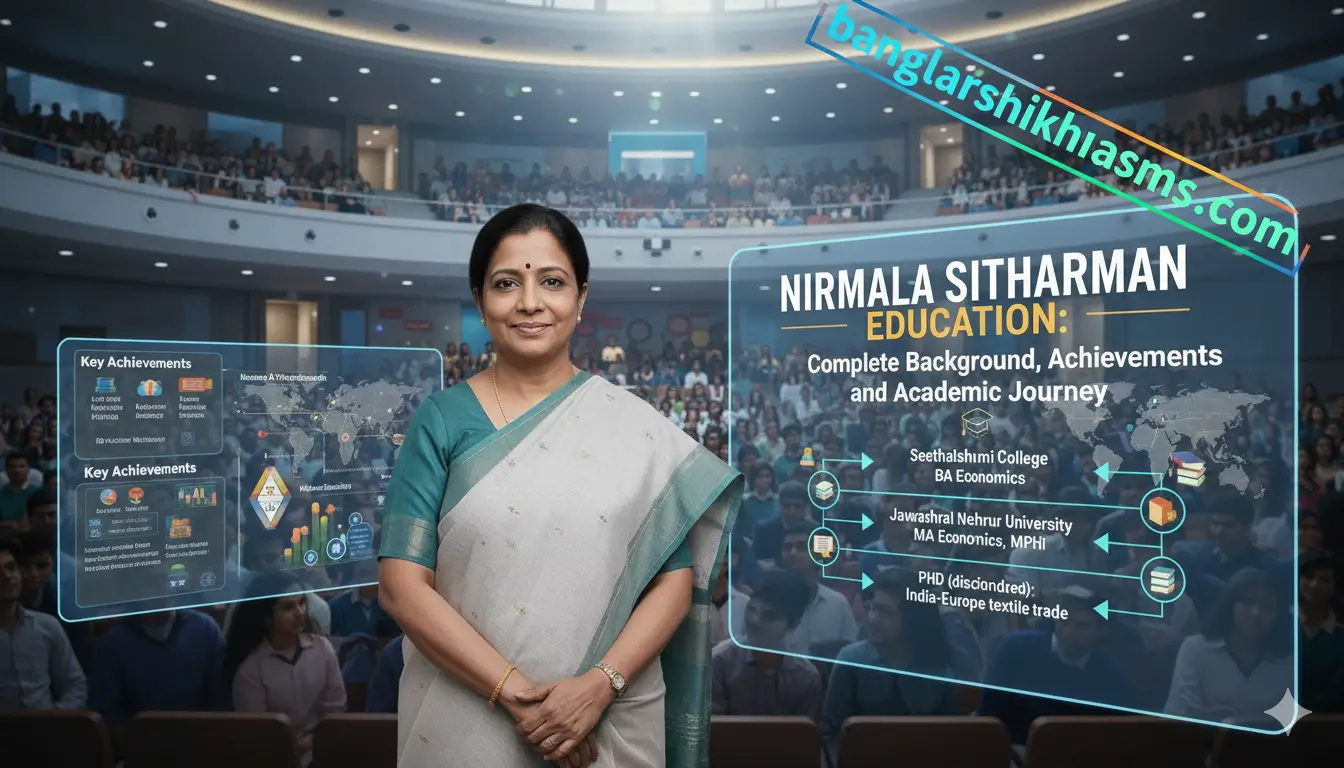
Welcome to banglar shiksha sms. Nirmala Sitharaman is one of India’s most prominent political leaders, serving as the Finance Minister and shaping the country’s economic policies with expertise and precision. Understanding Nirmala Sitharaman education provides valuable insight into the academic foundation that has contributed to her exceptional leadership skills and policy-making abilities. Her educational journey, from early schooling in Tamil Nadu to advanced studies in economics at prestigious institutions, reflects a combination of dedication, intellectual curiosity, and strategic thinking. By exploring her academic background, readers can gain a clear perspective on how education can influence a successful career in politics and governance.
“Education shapes leaders, and Nirmala Sitharaman academic journey demonstrates how knowledge becomes the foundation for impactful governance.”
Early Life and Schooling
Nirmala Sitharaman was born on 18 August 1959 in Madurai, Tamil Nadu, India. Her early life was marked by exposure to diverse cultural and educational environments. She spent her formative years attending schools in Chennai and Tiruchirappalli, which played a crucial role in developing her foundational skills.
Sitharaman completed her primary and secondary education at various institutions, including Sacred Heart Convent Anglo-Indian School in Villupuram. Her schooling emphasized core subjects like mathematics, economics, and languages, which later influenced her decision to pursue higher studies in economics.
“Strong foundational education equips leaders with the analytical tools required to navigate complex policy challenges.”
Her schooling years also instilled a sense of discipline, responsibility, and critical thinkingqualities that became integral to her approach in higher education and later professional life.
Read Also: Kavya Maran Education
Undergraduate Education
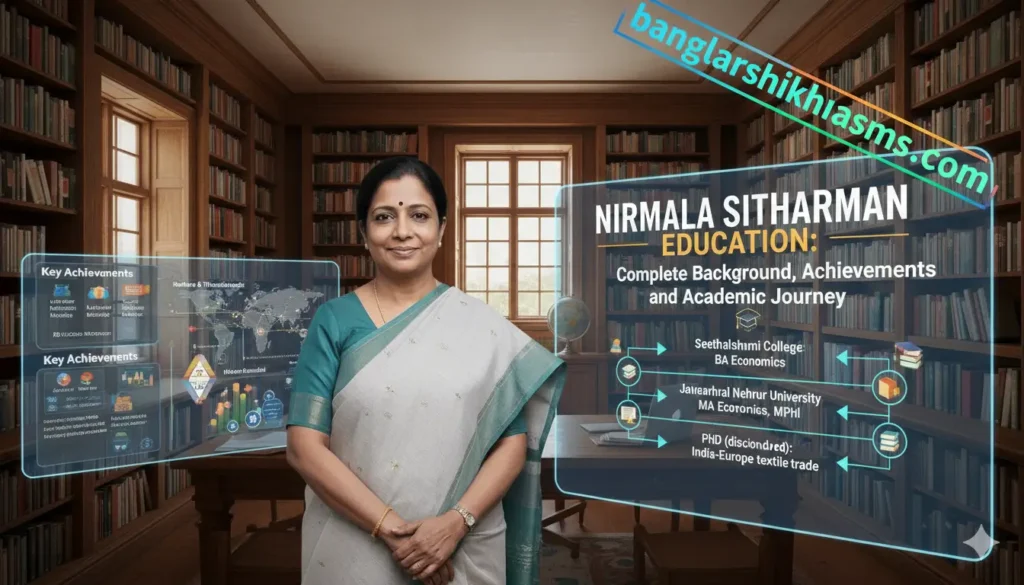
Nirmala Sitharaman pursued her undergraduate studies at Seethalakshmi Ramaswami College in Tiruchirappalli. She graduated with a Bachelor of Arts in Economics in 1980, achieving academic excellence in a field that forms the backbone of governance, finance, and policymaking.
During her undergraduate studies, Sitharaman developed a keen interest in macroeconomics, fiscal policy, and international trade. Her exposure to these subjects provided a strong foundation for understanding economic systems and their impact on national development.
“A robust undergraduate education in economics lays the groundwork for informed decisions in governance and financial planning.”
Her undergraduate degree not only equipped her with analytical skills but also introduced her to the principles of social and economic development, which would later influence her policymaking and political strategies.
Postgraduate Education
Following her undergraduate studies, Nirmala Sitharaman pursued a Master of Arts in Economics from Jawaharlal Nehru University (JNU), New Delhi, completing it in 1984. JNU is renowned for its rigorous academic programs and emphasis on critical thinking, which significantly shaped Sitharaman approach to economics and public policy.
Her postgraduate studies focused on advanced economic theories, international trade, and development economics. She also engaged in research projects that analyzed trade relations between India and other countries, developing a nuanced understanding of global markets.
“Postgraduate education bridges theoretical knowledge and practical policy application, creating leaders capable of handling national and international challenges.”
Sitharaman time at JNU provided her with an academic environment that encouraged debate, discussion, and research, essential skills for her later roles in the Ministry of Finance and Commerce.
M.Phil. and Research Work
Nirmala Sitharaman furthered her academic journey with an M.Phil. in Economics from JNU, specializing in Indo-European trade relations. Her research focused on understanding historical and contemporary trade practices between India and European nations, analyzing their impact on India’s economic growth.
This research experience honed her analytical skills, enabling her to interpret complex economic data and develop informed policy recommendations. The combination of rigorous academic research and practical insights prepared her for future policymaking responsibilities.
“Research is the bridge between academic theory and actionable policy, and it shaped Sitharaman strategic thinking in economic governance.”
Her M.Phil. work also strengthened her ability to present economic arguments clearly and persuasively, a skill she consistently applies in Parliament and policy discussions.
Professional Training and Early Career
While completing her academic journey, Nirmala Sitharaman gained practical experience in several professional roles, which complemented her formal education. She briefly worked with the BBC World Service and as a research assistant in economic organizations, gaining exposure to global economics and international trade.
Additionally, her tenure at PricewaterhouseCoopers (PwC) allowed her to analyze market trends, evaluate corporate strategies, and understand financial reporting, enhancing her practical knowledge of economics and finance.
“Practical experience bridges the gap between classroom learning and real-world application, an essential aspect of effective leadership.”
These experiences helped Sitharaman develop a holistic understanding of economics, policy-making, and financial management, equipping her to handle the responsibilities of high-level governmental roles.
Influence of Education on Political Career
Nirmala Sitharaman academic background in economics and international trade has been a cornerstone of her political and ministerial career. Her education has enabled her to analyze economic challenges, design effective policies, and communicate complex financial concepts to a wide audience.
As the Finance Minister of India, her decisions are informed by decades of academic and professional preparation. She applies analytical frameworks learned during her M.A. and M.Phil. studies to national fiscal policy, budgeting, and economic reforms.
“Strong academic foundations empower policymakers to create impactful, evidence-based strategies.”
Her education also contributes to her credibility and effectiveness in international negotiations, trade agreements, and economic forums, reflecting the global perspective gained during her postgraduate and professional experiences.
Key Academic Achievements
- Bachelor of Arts in Economics from Seethalakshmi Ramaswami College, 1980
Master of Arts in Economics from Jawaharlal Nehru University, 1984 - M.Phil. in Economics, specializing in Indo-European trade, JNU
- Enrolled in a Ph.D. program in Economics (not completed)
| Degree | Institution | Field of Study | Year |
| B.A. | Seethalakshmi Ramaswami College | Economics | 1980 |
| M.A. | Jawaharlal Nehru University | Economics | 1984 |
| M.Phil | Jawaharlal Nehru University | Economics (Indo-European Trade) | Mid-1980s |
| Ph.D. | Jawaharlal Nehru University (enrolled) | Economics | Not completed |
These academic milestones reflect a consistent focus on economics, international trade, and analytical rigor, forming the foundation of her professional and political success.
Lessons from Nirmala Sitharaman Education
- Interdisciplinary Learning: Combining economics, research, and international exposure cultivates versatile leaders.
- Analytical Thinking: Academic research sharpens critical thinking and problem-solving skills.
- Practical Application: Professional experiences complement academic knowledge and enhance decision-making.
- Global Perspective: Exposure to international systems helps in policy formulation and trade negotiations.
- Continuous Learning: Even unfinished Ph.D. studies demonstrate the importance of lifelong learning.
“Education is a lifelong journey, and every stage contributes to personal and professional growth.”
Nirmala Sitharaman Academic Influence on Policy Decisions
Nirmala Sitharaman educational foundation has directly influenced her approach to policymaking. Her decisions often reflect evidence-based analysis, historical trade knowledge, and economic principles learned during her academic years. Some notable areas where her education impacts policy include:
- National Budget Planning: Applying macroeconomic concepts to balance fiscal policy.
- International Trade Negotiations: Leveraging knowledge of historical and modern trade patterns.
- Economic Reforms: Understanding systemic challenges and proposing structural solutions.
- Financial Literacy Initiatives: Promoting awareness through programs informed by economics expertise.
Her education enables her to approach challenges methodically, combining theoretical understanding with practical solutions.
Nirmala Sitharaman Education and Gender Empowerment
As one of India’s most influential female politicians, Nirmala Sitharaman serves as a role model for young women pursuing careers in economics, finance, and politics. Her academic achievements highlight the importance of education in overcoming gender barriers and attaining leadership positions.
“Empowered education paves the way for women to lead with confidence, competence, and vision.”
Her journey demonstrates that academic excellence, combined with professional diligence, can propel women into positions of national and international significance.
Frequently Asked Questions
What is Nirmala Sitharaman educational background?
Nirmala Sitharaman completed her Bachelor of Arts in Economics from Seethalakshmi Ramaswami College and earned a Master’s and M.Phil. in Economics from Jawaharlal Nehru University, focusing on Indo-European trade.
Did Nirmala Sitharaman complete a Ph.D.?
She enrolled in a Ph.D. program in Economics at JNU but did not complete it due to professional and personal commitments.
How has her education influenced her political career?
Her strong foundation in economics and research enables her to analyze complex financial policies, guide national budgets, and negotiate international trade effectively.
Which subjects did she specialize in during her studies?
She specialized in economics, international trade, and development economics, with a particular focus on historical and contemporary Indo-European trade relations.
What professional experience complemented her education?
Sitharaman gained practical experience at PwC, BBC World Service, and economic research organizations, enhancing her application of academic knowledge in real-world policy.
Why is Nirmala Sitharaman education considered inspiring?
Her academic journey demonstrates how rigorous education, analytical thinking, and continuous learning empower leaders to succeed in governance and public service.
Conclusion
Nirmala Sitharaman education has been a cornerstone of her remarkable career, providing the knowledge, analytical skills, and global perspective needed for effective leadership. From her early schooling in Tamil Nadu to her advanced studies in economics at Jawaharlal Nehru University, each stage of her academic journey shaped her approach to policy-making and governance. Her M.Phil. research in Indo-European trade and professional experiences further strengthened her expertise in economics and finance. Understanding Nirmala Sitharaman education highlights how rigorous academic preparation, combined with practical experience, can empower leaders to navigate complex national and international challenges. Her journey serves as an inspiring example of education driving excellence in public service.
