

Welcome to banglarshikshasms Education has always played a decisive role in shaping societies and empowering individuals. In the history of India, the importance of education becomes especially clear when examining the life of Bhimrao Ramji Ambedkar. His journey proves that education can challenge injustice, dismantle inequality, and transform not only a single life but the direction of an entire nation.
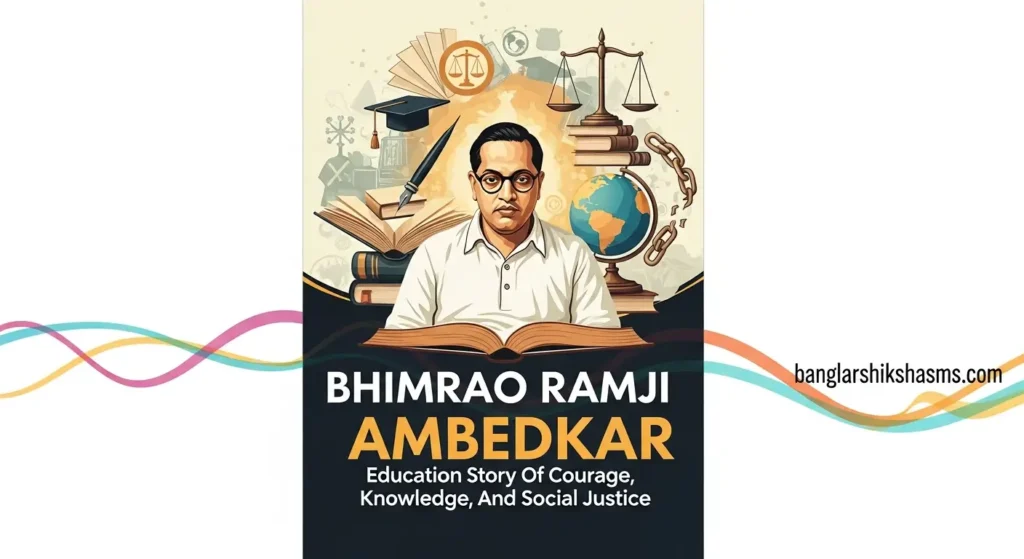
Bhimrao Ramji Ambedkar education is a remarkable example of determination, intellectual excellence, and unwavering belief in the power of knowledge.
Born into a deeply discriminatory social system, Ambedkar faced obstacles that were designed to prevent him from learning. Despite these hardships, he pursued education with discipline and purpose. His academic journey across India, the United States of America, and the United Kingdom reflects his belief that education is the strongest weapon against social oppression. This article presents a detailed and focused exploration of Bhimrao Ramji Ambedkar education, highlighting his early schooling, higher studies, global exposure, and lasting educational vision.
Education was not a privilege for Ambedkar. It was a necessity for dignity and freedom.
Early Life and the Beginning of Education
Social Background and Family Influence
Bhimrao Ramji Ambedkar was born on April eighteen ninety one in Mhow, which was a military cantonment during British rule. He belonged to the Mahar community, which was placed at the lowest level of the caste hierarchy. Social discrimination was a daily reality for people in his community.
His father, Ramji Maloji Sakpal, served in the British Indian Army and strongly believed in discipline and education. He encouraged his children to study despite social barriers. This support laid the foundation for Bhimrao Ramji Ambedkar education and helped him develop respect for learning from an early age.
Experiences of Discrimination in School
Ambedkar attended government schools where he faced severe discrimination. He was forced to sit separately from other students and was often denied access to drinking water. Teachers avoided touching his notebooks, and classmates treated him as inferior.
These humiliating experiences could have ended his education. Instead, they strengthened his determination. He realized that education was the only path that could give him self-respect and intellectual independence.
The classroom became Ambedkar’s first battlefield against inequality.
Primary and Secondary Education
Early Schooling Challenges
During his primary education, Ambedkar struggled with both social rejection and emotional pain. He was treated as an outsider in spaces meant for learning. Despite these hardships, he showed exceptional concentration and curiosity.
His ability to remain focused on studies under such conditions highlights the strength of his character. Bhimrao Ramji Ambedkar education began with perseverance rather than comfort.
Matriculation and a Historic Moment
In nineteen hundred seven, Ambedkar passed the matriculation examination from Elphinstone High School in Bombay. This achievement was historic because very few individuals from his community had reached this level of education.
The event was celebrated by social reformers who recognized its importance. It proved that caste-based barriers could be challenged through education and determination.
Ambedkar’s matriculation was not only a personal success. It was a collective hope.
College Education and Intellectual Growth
Admission to Elphinstone College
After matriculation, Ambedkar enrolled at Elphinstone College under the University of Bombay. This stage of education allowed him to study economics, political science, and history in depth.
College life exposed him to academic debates and critical thinking. Although discrimination did not disappear, his growing intellectual confidence helped him navigate these challenges.
Bachelor of Arts Degree
In nineteen hundred twelve, Ambedkar completed his Bachelor of Arts degree. His academic interests focused on economic inequality, governance, and social organization. These subjects later shaped his contributions to social reform and constitutional development.
Bhimrao Ramji Ambedkar education during his college years strengthened his analytical thinking and broadened his understanding of society.
Knowledge gave Ambedkar the courage to challenge unjust traditions.
Higher Education in the United States of America
Scholarship and Journey Abroad
One of the most transformative moments in Bhimrao Ramji Ambedkar education occurred when he received a scholarship from the Baroda State. This scholarship allowed him to study in the United States of America.
In nineteen hundred thirteen, Ambedkar traveled to New York and joined Columbia University. For the first time, he experienced a society where his caste did not determine his worth.
Academic Environment at Columbia University
At Columbia University, Ambedkar studied economics, sociology, philosophy, and political theory. He completed his Master of Arts degree in nineteen hundred fifteen.
The academic environment encouraged free discussion and critical inquiry. Professors recognized his intellectual brilliance and dedication. This period played a crucial role in shaping his democratic and egalitarian beliefs.
Education abroad gave Ambedkar freedom of thought and confidence of voice.
Doctoral Studies and Research Excellence
Research in Economics
Ambedkar continued his studies at Columbia University and pursued advanced research in economics. His scholarly work focused on public finance, administration, and economic inequality in India.
His research demonstrated originality and depth. It reflected his ability to combine academic theory with real social problems.
Academic Discipline and Maturity
Doctoral studies refined Ambedkar’s research skills and intellectual discipline. Bhimrao Ramji Ambedkar education at this level prepared him to engage with complex policy and social reform issues.
This stage of education strengthened his belief that economic justice is essential for social equality.
Education in the United Kingdom
Studies at the London School of Economics
After completing his studies in the United States of America, Ambedkar continued his education in the United Kingdom. He enrolled at the London School of Economics to study economics and political science.
The academic rigor of the institution further developed his analytical abilities. He studied economic systems, governance structures, and social policy in depth.
Legal Education and Barrister Training
Alongside economics, Ambedkar studied law at Gray’s Inn in London. He completed his legal training and became a qualified barrister.
This legal education later enabled him to play a leading role in drafting constitutional principles. Bhimrao Ramji Ambedkar education uniquely combined economics, law, and political thought.
Education gave Ambedkar the tools to build justice through law.
Financial and Emotional Struggles During Education
Economic Hardships
Despite scholarships, Ambedkar faced financial difficulties during his studies abroad. Limited resources forced him to live modestly and manage expenses carefully.
These hardships deepened his understanding of how poverty restricts access to education. His experiences strengthened his commitment to educational equality.
Emotional Impact of Past Discrimination
Although he found respect abroad, memories of discrimination in India remained painful. These experiences fueled his desire to return and work for social reform.
Education became both a personal journey and a social mission.
Educational Philosophy of Bhimrao Ramji Ambedkar
Education as Empowerment
Ambedkar believed education was the foundation of social empowerment. He argued that political rights alone could not bring equality without education and economic opportunity.
Bhimrao Ramji Ambedkar education represented liberation from ignorance, fear, and submission.
Education is the path from oppression to self-respect.
Emphasis on Critical Thinking
Ambedkar rejected blind tradition and promoted rational thought. He believed education should teach individuals to question injustice and think independently.
This philosophy remains relevant in modern education systems.
Contribution of Education to His National Role
Role in Constitution Making
Ambedkar’s extensive education enabled him to draft a constitution that emphasized equality, justice, and fundamental rights. His legal and economic knowledge ensured balanced governance principles.
Bhimrao Ramji Ambedkar education directly influenced the democratic foundation of India.
Advocacy for Equal Educational Access
He strongly supported educational opportunities for marginalized communities. He believed reservations and institutional support were necessary to correct historical injustice.
His life proved that talent exists in all communities when given opportunity.
Educational Institutions and Legacy
Promotion of Learning Initiatives
Ambedkar encouraged the establishment of educational institutions for disadvantaged groups. He supported literacy movements and community education.
His efforts aimed to create long-term social transformation.
Influence on Modern Education
Today, his educational philosophy inspires students, teachers, and policymakers. His life story continues to motivate individuals facing social barriers.
Ambedkar’s education became a bridge between knowledge and justice.
Key Lessons from Bhimrao Ramji Ambedkar Education
Perseverance Against Barriers
Ambedkar’s journey shows that perseverance can overcome even systemic discrimination.
Purpose Driven Learning
His education was guided by social responsibility, not personal prestige.
Global Perspective with Local Impact
International education helped him apply global ideas to Indian social challenges.
Frequently Asked Questions About Bhimrao Ramji Ambedkar Education
Who was Bhimrao Ramji Ambedkar?
Bhimrao Ramji Ambedkar was a social reformer, jurist, economist, and the principal architect of the Indian Constitution. He dedicated his life to fighting caste discrimination and promoting social equality through education.
What was Bhimrao Ramji Ambedkar’s early education like?
Ambedkar faced severe discrimination in his early schooling due to his caste. Despite being treated as inferior and denied basic facilities, he remained determined and excelled academically, completing his matriculation from Elphinstone High School in Bombay.
Where did Bhimrao Ramji Ambedkar pursue higher studies?
Ambedkar studied at Elphinstone College in India for his undergraduate degree. He then went to Columbia University in the United States for a Master’s and a doctorate in Economics. Later, he studied law at Gray’s Inn and economics at the London School of Economics in the United Kingdom.
How did education influence Ambedkar’s life?
Education was central to Ambedkar’s life. It empowered him to challenge social injustices, understand economic inequality, and draft the Indian Constitution. He viewed education as a tool for social liberation and personal empowerment.
What subjects did Ambedkar study during his academic career?
Ambedkar studied Economics, Political Science, Sociology, Philosophy, and Law. His interdisciplinary knowledge helped him analyze social problems and propose effective reforms.
What was Ambedkar’s vision of education for society?
Ambedkar believed education should be accessible to all, especially marginalized communities. He emphasized critical thinking, rational inquiry, and the use of knowledge to promote social justice and equality.
Conclusion
Bhimrao Ramji Ambedkar education is a powerful example of how knowledge can transform both individual lives and national destiny. From a childhood marked by discrimination to academic excellence across continents, his journey proves that education is the strongest force against injustice. His studies in economics, law, and political theory equipped him to challenge inequality and design a democratic framework based on dignity and rights. More importantly, his educational philosophy emphasized inclusion, critical thinking, and empowerment. His life teaches that education must be accessible, purposeful, and socially responsible. When guided by courage and compassion, education becomes the foundation of lasting social change.
Bhimrao Ramji Ambedkar education reminds us that learning is the first step toward freedom.
