

Welcome to banglar shiksha sms. School Education in Karnataka has undergone a significant transformation over the years, emerging as a system that balances academic excellence with holistic development. The school education in Karnataka framework emphasizes not only core subjects like mathematics, science, and languages but also encourages extracurricular activities, moral education, and life skills. With a variety of boards, including the state syllabus, CBSE, and ICSE, Karnataka provides students with multiple pathways to achieve academic and personal growth. Parents and students seeking quality education can benefit from understanding the curriculum, admission processes, and diverse opportunities that Karnataka schools offer. This guide explores every aspect of the school education system in Karnataka, helping families make informed decisions about their child’s educational journey.
“Karnataka’s school education system empowers students with knowledge, skills, and values, preparing them for future success in academics and life.”
Overview of School Education in Karnataka
Karnataka has a diverse and well-structured education system that caters to students from various backgrounds. The state offers multiple educational boards, mediums of instruction, and learning frameworks to meet the needs of its population. Understanding the overall structure of school education in Karnataka is the first step for parents and students planning their academic journey.
Key Features of Karnataka’s School Education
- Diverse Board Options: Karnataka offers education under the state syllabus, CBSE, ICSE, and international boards like IGCSE in selected schools.
- Multiple media of Instruction: Kannada, English, and other regional languages serve as media, promoting linguistic diversity.
- Inclusive Education: Policies ensure equal access for students from different socio-economic backgrounds, including children with special needs.
- Focus on Holistic Development: Emphasis is placed on extracurricular activities, sports, moral education, and life skills alongside academics.
“Karnataka’s school system emphasizes inclusivity, offering students from diverse backgrounds access to quality education.”
The Karnataka Department of Public Instruction actively manages government schools, while private institutions operate under regulated guidelines. Both sectors aim to maintain high standards of education, preparing students for higher studies and professional opportunities.
Read Also: west bengal board of secondary education
Structure of School Education in Karnataka
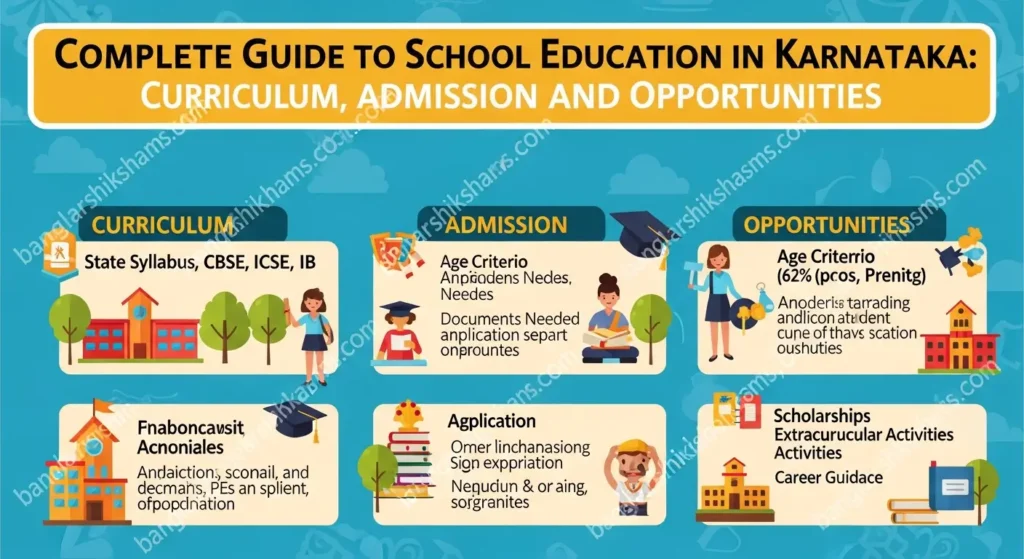
School education in Karnataka is structured to follow a systematic progression from foundational learning to higher secondary education. This structure ensures students develop academic, social, and personal skills progressively.
Primary Education (Classes 1 to 5)
Primary education lays the foundation for literacy, numeracy, and social skills. Schools focus on:
- Reading, writing, and comprehension skills in Kannada, English, or other regional languages
- Basic mathematics, science, and environmental studies
- Introduction to arts, music, and physical education
The state encourages a child-centric approach, where teaching methods involve interactive activities, storytelling, and practical exercises.
Upper Primary Education (Classes 6 to 8)
Upper primary education expands students’ knowledge base and introduces them to more structured subjects:
- Mathematics, Science, Social Studies, and Languages
- Moral and value education, emphasizing civic responsibility
- Enhanced focus on physical education, sports, and creative skills
“Upper primary education bridges foundational learning with analytical thinking, preparing students for secondary education challenges.”
Teachers use innovative learning tools, including digital classrooms, to enhance student engagement. Assessment methods move beyond rote memorization to include projects and practical evaluations.
Secondary Education (Classes 9 to 10)
Secondary education in Karnataka prepares students for board examinations under the Karnataka Secondary Education Examination Board (KSEEB) or other boards like CBSE and ICSE. Key aspects include:
- Comprehensive coverage of Science, Mathematics, Social Science, and Languages
- Continuous assessment through internal tests, projects, and exams
- Career counseling and skill development initiatives
At this stage, students are encouraged to identify their strengths and interests, which helps guide their choice of streams in higher secondary education.
Higher Secondary Education (Classes 11 and 12)
Higher secondary education, often referred to as pre-university education, is crucial for career planning and higher studies. Students choose streams based on their academic and career aspirations:
- Science Stream: Physics, Chemistry, Biology, Mathematics, and Computer Science
- Commerce Stream: Accountancy, Business Studies, Economics, and Mathematics
- Arts/Humanities Stream: History, Political Science, Sociology, Psychology, and Languages
“Higher secondary education in Karnataka empowers students to specialize in areas aligned with their career goals while maintaining a strong academic foundation.”
Schools also provide career guidance programs, aptitude tests, and skill-based learning to help students make informed decisions about higher education or vocational paths.
Curriculum in Karnataka Schools
The curriculum in Karnataka is designed to ensure holistic learning, critical thinking, and practical knowledge. It balances academics with co-curricular and life skills education, preparing students for future challenges.
State Board Curriculum
The Karnataka state syllabus is followed in most government and private schools. Key features include:
- Kannada is the primary language, with English as a secondary language
- Emphasis on foundational literacy and numeracy
- Inclusion of environmental education, physical education, and arts
- Continuous assessment to track student progress
“The Karnataka state curriculum integrates local culture and language, fostering a strong connection between students and their community.”
CBSE Curriculum in Karnataka
Many private schools in Karnataka offer the CBSE (Central Board of Secondary Education) curriculum. Its features are:
- Emphasis on science, technology, and mathematics
- Skill-based and activity-oriented learning
- Focus on conceptual understanding rather than memorization
- Standardized assessment across India
ICSE Curriculum in Karnataka
Some elite schools offer ICSE (Indian Certificate of Secondary Education) board education:
- Strong focus on English and language proficiency
- Broad subject choices and project-based learning
- Global perspective in education, preparing students for international opportunities
Digital and Innovative Learning Approaches
Karnataka schools are increasingly integrating digital classrooms, e-learning platforms, and smart boards. These innovations support interactive learning and enhance student engagement.
Admission Process in Karnataka Schools
Admission to schools in Karnataka follows a structured and transparent process, governed by government regulations and board guidelines. Understanding the admission procedure helps parents secure the right school for their child.
Government School Admissions
Government schools in Karnataka follow the Right to Education (RTE) guidelines, ensuring access for all students. Key points include:
- Online application for RTE quota seats
- Reservation for economically weaker sections, girls, and marginalized communities
- Transparent seat allocation based on merit and random selection
Private School Admissions
Private schools follow both board regulations and state directives:
- Admissions usually begin in December or March for the next academic year
- No capitation fees or interviews are permitted for regular admission
- Parents can access admission notices, seat availability, and fee structures online
“Transparent admission policies ensure fairness and equal opportunity for all students seeking quality education.”
Pre-University Admissions
After class 10, students can enroll in pre-university colleges (PUC), which often require:
- Submission of previous academic records
- Choosing the preferred stream (Science, Commerce, or Arts)
- Meeting the minimum marks criteria, depending on the institution
Opportunities for Students in Karnataka
Karnataka offers a wide array of opportunities in academics, sports, and skill development. These opportunities help students explore interests beyond the classroom and prepare for competitive careers.
Academic Opportunities
- Scholarships and Merit-Based Awards: For top-performing students across various boards
- STEM Programs: Special programs in mathematics, robotics, and science competitions
- Language and Literature Programs: Encouraging multilingual proficiency
Sports and Extracurricular Opportunities
- Inter-school competitions in football, cricket, athletics, and other sports
- Participation in cultural events, debates, and quiz competitions
- Skill development workshops in art, music, and theatre
Vocational and Skill-Based Opportunities
- Vocational training courses in IT, hospitality, and other emerging industries
- Entrepreneurship programs for school-level innovators
- Internship opportunities with educational institutions and NGOs
“Karnataka schools focus on holistic development, offering students opportunities that extend far beyond traditional academics.”
Medium of Instruction in Karnataka Schools
The medium of instruction plays a crucial role in shaping students’ learning experience. Karnataka supports multiple media, catering to linguistic diversity.
Kannada Medium Schools
- Primary language is Kannada, with English taught as a second language
- Focuses on regional culture, literature, and social studies
- Encourages students to maintain their cultural identity
English Medium Schools
- Widely preferred in urban areas and private schools
- Emphasis on global communication skills and competitive examinations
- Aligns with national and international curriculum standards
Other Regional Languages
- Schools in border districts may offer Telugu, Marathi, or Tamil as a medium.
- Promotes inclusivity and respects local linguistic diversity
Assessment and Evaluation in Karnataka
Assessment in Karnataka schools has evolved from rote learning to comprehensive evaluation systems that measure understanding, creativity, and practical knowledge.
Continuous and Comprehensive Evaluation (CCE)
- Introduced in the primary and upper primary levels
- Includes periodic assessments, projects, and oral tests
- Helps identify strengths and weaknesses early
Board Examinations
- Secondary (Class 10) and higher secondary (Class 12) board exams are mandatory.
- Standardized assessment ensures fair comparison across schools
- Focus on problem-solving and analytical skills
“Modern assessment methods in Karnataka encourage students to think critically and apply knowledge practically.”
Challenges in School Education in Karnataka
Despite significant progress, Karnataka faces challenges that affect quality and accessibility.
- Urban-Rural Disparity: Quality of infrastructure and teaching varies significantly
- Teacher Shortages: Especially in remote areas, affecting learning outcomes
- Pressure of Competitive Exams: Stress and Mental Health Concerns Among Students
- Digital Divide: Not all students have access to e-learning tools
Efforts are ongoing to address these challenges, including teacher training programs, digital classroom initiatives, and inclusive policies.
Future Prospects of School Education in Karnataka
Karnataka continues to invest in improving school education through technology, policy reforms, and skill-based learning. Future trends include:
- Smart classrooms and AI-based learning platforms
- Curriculum revisions to include coding, robotics, and environmental studies
- Greater focus on vocational training and career readiness
- Strengthening public-private partnerships to improve school infrastructure
“The future of Karnataka school education lies in innovation, inclusivity, and preparing students for a rapidly evolving world.”
Frequently Asked Questions
What is the structure of school education in Karnataka?
School education in Karnataka is divided into primary (classes 1–5), upper primary (classes 6–8), secondary (classes 9–10), and higher secondary (classes 11–12), with multiple boards like State Board, CBSE, and ICSE.
What boards are available in Karnataka schools?
Students in Karnataka can enroll in the State Board, CBSE, ICSE, or select international boards depending on the school.
What is the medium of instruction in Karnataka schools?
Karnataka schools offer Kannada, English, and other regional languages as mediums of instruction, ensuring both local and global language proficiency.
How does admission work in Karnataka schools?
Government schools follow RTE guidelines with reservations, while private schools follow transparent admission policies with no capitation fees or interviews.
What subjects are included in the Karnataka curriculum?
The curriculum covers languages, mathematics, science, social studies, arts, and physical education, with a focus on holistic development and skill-building.
What extracurricular opportunities are available for students?
Students can participate in sports, arts, cultural events, competitions, and vocational training programs to enhance personal growth and skills.
How does Karnataka ensure quality education in schools?
Through teacher training, digital classrooms, continuous assessment, curriculum reforms, and inclusive policies, Karnataka ensures high-quality education and better learning outcomes.
Conclusion
The school education system in Karnataka offers a well-structured and inclusive framework that ensures quality learning for students from diverse backgrounds. With multiple boards, mediums of instruction, and a focus on holistic development, Karnataka schools prepare students for both academic success and personal growth. Transparent admission processes, skill-based programs, and extracurricular opportunities enhance student engagement and learning outcomes. Despite challenges like urban-rural disparities and digital gaps, ongoing reforms, innovative teaching methods, and supportive policies continue to improve the education landscape. Understanding the curriculum, admission procedures, and opportunities enables parents and students to make informed decisions, ensuring a strong foundation for a successful academic and professional future.
